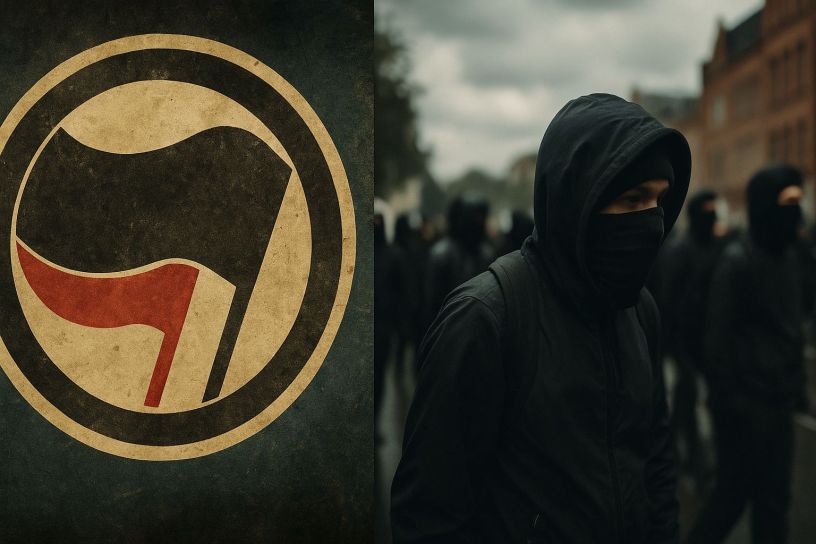
Antifa didn’t fall out of the sky in 2017 with foreign funding and a secret headquarters. It’s not a Marvel villain franchise with uniforms, central command, and a sinister recruitment office. The truth is messier, older, and — inconvenient for conspiracy theorists — far more local.
Act I: Europe before “Antifa” became a buzzword
The roots go back almost a century. In 1930s Germany, groups under the name Antifaschistische Aktion organized against Hitler’s rising Nazis. They weren’t polite debaters in tweed jackets — they were workers, students, and activists who understood fascism wasn’t going to be reasoned with. The name and the black-and-red symbolism stuck, and decades later it would reappear wherever far-right movements gained traction.
The early Antifa activists were brutally suppressed after the Nazis seized power, but their defiance became a symbol. Postwar, antifascist cells survived in underground networks, especially in West Germany, where ex-Nazis were reintegrated into public life. For radicals, “antifascism” meant unfinished business — a refusal to let authoritarianism creep back under new names.
The message spread across Europe during the Cold War, inspiring movements in Italy, the UK, and beyond. By the 1970s, clashes between fascist street gangs and antifascist activists were common in cities like London. It was never about centralization. It was about local communities refusing to cede space to extremists.
Act II: U.S. import, punk-style
Fast-forward to the 1980s U.S. Hardcore punk scenes in places like Minneapolis and New York became breeding grounds for anti-racist skinhead collectives and militant anti-KKK groups. Think less “international conspiracy,” more “kids in leather jackets refusing to let neo-Nazis take over their clubs.” By the 1990s, organizations like Anti-Racist Action (ARA) were showing up at white supremacist rallies, using direct action tactics — shouting, blockading, sometimes brawling — to keep extremists from organizing openly.
The punk ethos mattered. Antifa in America grew out of subcultural spaces where fascist recruiters were trying to poach angry youth. Bands, zines, and community centers became the laboratories for antifascist resistance. Instead of waiting for institutions to respond, teenagers with guitars and spray paint decided to push Nazis out themselves.
These scenes connected with broader anti-racist struggles of the era. ARA didn’t just fight skinheads in mosh pits; they also tracked Klan rallies, disrupted meetings, and shared intelligence with civil rights groups. It was grassroots, messy, and sometimes violent — but it created a template that future antifascist networks would use again.
Act III: Post-9/11 to the alt-right era
For years, Antifa in the U.S. was fringe, a subculture of radical leftists, anarchists, and anti-racist groups. They weren’t on CNN; they were a handful of people counter-protesting the Klan in rural towns. That changed in the mid-2010s, when the alt-right’s rise made antifascist tactics suddenly visible again. Charlottesville’s “Unite the Right” rally in 2017 threw Antifa into the spotlight — black-clad counter-protesters facing down tiki-torch Nazis. Media outlets, politicians, and internet outrage cycles inflated the image into something far bigger than the reality.
In this era, Antifa’s visibility outstripped its size. A few hundred masked protesters clashing in Portland were suddenly treated as though they were a nationwide army. Social media amplified images of black blocs, while politicians weaponized the term “Antifa” as a catchall for left-wing unrest.
The irony is that Antifa didn’t suddenly grow — the far right did. White nationalist groups, emboldened by online echo chambers, marched more openly than they had in decades. Antifa was reactive: showing up to block fascists where they appeared. But cameras and clicks turned their presence into spectacle, feeding both fear and fascination.
Act IV: The myth of the centralized menace
By 2020, Antifa had become a political football. Some on the right painted it as a terrorist organization with command centers, payrolls, and foreign sponsors. None of that holds water. Antifa is not an organization — it’s a loose label anyone can adopt if they’re committed to opposing fascism, often through direct action. No membership cards. No HR department. Just networks of local groups who sometimes coordinate, sometimes don’t, united more by attitude than infrastructure.
The myth of centralization was politically useful. It turned a scattered, decentralized protest culture into a shadowy supervillain. This narrative helped justify crackdowns, distracted from deeper social unrest, and fueled endless news cycles about “Antifa terrorists.” It was more convenient to imagine a puppet master than to acknowledge ordinary people deciding to fight fascists on their own.
In reality, what exists are small affinity groups — friends, neighbors, activists — sharing tactics, flyers, and sometimes bail funds. No international bankrolling. No master plan. Just a patchwork of direct-action crews keeping alive the old antifascist impulse: don’t wait for institutions to act against fascism; do it yourselves.
What Antifa really is
- A tactic, not an army. Wearing black, masking up, and moving as a bloc is a protest style — not a uniformed militia.
- A decentralized movement. Chapters in Portland don’t report to chapters in New York. Each scene runs on its own momentum.
- Reactive, not proactive. They tend to mobilize when far-right groups march or organize, not as an all-purpose revolutionary vanguard.
This is why Antifa feels so amorphous: because it is. Some people calling themselves Antifa may organize a food drive, others may chain themselves across a road to stop a white nationalist rally. What unites them is a refusal to let fascists occupy public space unopposed.
It’s also why attempts to ban or designate Antifa as a terrorist group run into a wall. You can’t outlaw a protest tactic or a label anyone can pick up. You can punish acts of violence or vandalism — and authorities do — but you can’t ban an idea.
Why the confusion sticks
Conspiracy theories about Antifa thrive because they’re useful. Painting a decentralized, scrappy protest culture as a monolithic terrorist force gives politicians a boogeyman to rally against. It also erases the real conversation: why do far-right rallies keep popping up, and why do ordinary people feel compelled to risk arrest — or worse — to confront them?
The mythology serves media, too. “Antifa” sells better than “a few hundred local protesters.” Footage of masked crowds is more gripping than nuanced reports about community defense. So the legend of Antifa as a shadow army lives on, despite reality being closer to scattered local activism.
The effect is chilling: it discourages nuance and makes honest debate harder. If Antifa is always cast as an imported terrorist threat, then examining its real roots — punk scenes, anti-racist actions, local counter-protests — never happens. Myths win, history loses.
Bottom line
Antifa in the U.S. didn’t arrive in crates shipped by foreign agents. It evolved here, step by step: from punk clubs to small town counter-rallies, from fringe direct-action crews to headline-grabbing clashes when the alt-right surged. You can disagree with their tactics — plenty of people do. But calling Antifa a foreign paramilitary organization isn’t history. It’s fan fiction.
Discover more from Adrian Cruce's Blog
Subscribe to get the latest posts sent to your email.
 Adrian Cruce's Blog