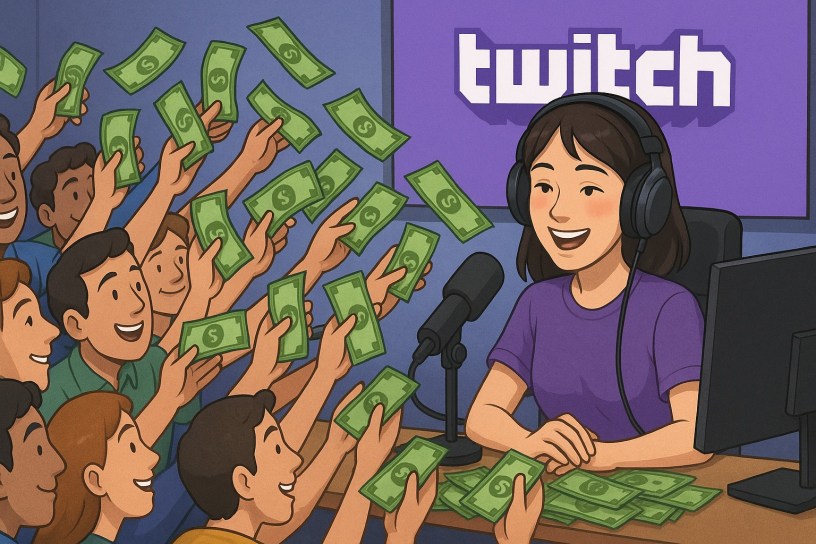
Alright, champ. Sit down. Take a breath. Close that donation screen. This isn’t an intervention. This is a wake-up slap delivered with the loving force of a brick lobbed through your Twitch app.
You sent $300 to a dude/gal on the internet. Not a charity. Not a friend in need. A person. Playing video games. Saying “yo thanks” while not even making eye contact with the camera. And look—I’m not judging. I’ve been around long enough to see what happens next, and spoiler: it’s not a “thank you” call. It’s a VIP badge and a lifetime of parasocial delusion.
I’m not here to make you feel bad. I’m here to make you feel aware. That money wasn’t thrown into a wishing well—it was chucked into a branding funnel so tight it makes a Dyson vacuum jealous. And at the bottom? Not friendship. Not appreciation. Just a bigger streamer with a new gaming chair and a slightly more inflated ego. Courtesy of you.
The Parasocial Pyramid Scheme
Let’s break this down like a bad speedrun. You think you’re close to this streamer. Why? Because he said “love ya, chat,” after a W, and your dopamine-starved brain went, “He means me.” Brother, no. You and 3,000 other usernames in chat are all competing in a one-sided emotional Hunger Games.
He doesn’t know your name. He knows your wallet.
The parasocial economy runs on false familiarity. It’s engineered. Calculated. Deliberate. Streamers farm attachment the same way Clash of Clans farms gems—slow, sneaky, and built to convert. Every “yo, I appreciate you” is a well-oiled step in the funnel from anonymous viewer to emotionally-invested donor. You’re not special. You’re just ahead of the addiction curve.
And the more you pay, the more it feels like you should matter. You’ve spent more than some people spend on their damn pets. And for what? To be a fleeting line of text in a chat moving faster than your coping mechanisms? This isn’t mutual. It’s performance-enhanced validation. And it’s for sale.
“But I Like Supporting Him”
Cool. Support away. But understand the rules of the game. You’re not investing in a friendship—you’re donating to a business. You’re an unpaid intern emotionally invested in someone else’s brand.
It’s like tipping the CEO of McDonald’s because he flipped a burger once on stream.
There’s nothing wrong with support. What’s wrong is pretending it’s more than it is. You can enjoy the content and still keep your head on straight. The problem starts when you think your financial support entitles you to recognition, favor, or access. That’s not how this works. This isn’t a Kickstarter where friendship is the reward tier. This is a one-way value stream, and you’re on the giving end.
And the kicker? They want you to think you’re special. Because that’s what keeps the money flowing. Emotional manipulation isn’t always sinister—it’s subtle, polished, and wrapped in community vibes. But once you zoom out, it looks a lot like grooming loyalty with digital pats on the head.
Streamers Are Entertainers, Not Entitled Emotional Support Animals
Here’s the truth: streamers aren’t your friends. And that’s fine. They’re performers. Some of them are amazing entertainers, therapists-by-proxy, chaotic gremlins who turn your bad day into a tolerable one. That’s valuable. But once you blur the line between content and companionship, you’re in trouble.
They aren’t signing your birthday card. They don’t owe you a hug. If you think they do, you’re not a fan—you’re a customer with attachment issues.
The moment you start expecting emotional returns on your donation investment, you’ve gone full crypto simp—throwing digital coins at charisma and hoping for affection. Don’t. That’s not their job. And frankly, you’re being unfair to them too. Expecting a streamer to act like your therapist, your hype man, and your best friend? That’s not sustainable. That’s a burnout recipe marinated in entitlement.
Let them be what they are: curated chaos piped into your life on a schedule. Laugh, cry, vibe—but don’t delude yourself into thinking their “how’s everyone doing today?” is a personal check-in. It’s crowd work, not connection. And if you’re mistaking one for the other, that’s on you.
“But He Said My Name!”
Yeah, and your Starbucks barista does too when your drink’s ready. Doesn’t mean you’re besties. You need to understand the mechanics of modern entertainment. Streamers are trained to make hundreds feel special at once. That’s their job. That’s how the content sausage gets made. And it’s impressive. But that eye contact? That “we’re in this together” vibe? It’s a performance optimized by years of analytics, chat behavior patterns, and emotional bait.
You’re not crazy for feeling connected. That’s what the parasocial machine wants.
He read your name because you paid for it—or because the algorithm blessed you. Either way, the intimacy is synthetic. It’s theater. And if you mistake applause for friendship, you’re setting yourself up for disappointment. You’re a line in a script. A floating username. Not a character in his life. You are not the main character in someone else’s Twitch stream.
And if he didn’t read your name? If your $50 dono got steamrolled by a fake raid? You felt it, didn’t you? That little heartbreak. That pang. That’s your reality-check organ kicking back in. Don’t ignore it.
So… Am I Just Dumb?
No, but you are in denial. And I say this with love.
Because it’s not about the money. It’s about the illusion of intimacy. And the only one getting paid for that illusion is not you.
You’re not dumb. You’re lonely. And that’s okay. Most of us are, to some degree. But when you start trying to fill that hole with emotes, badges, and tier-3 subs, you’re putting duct tape on a cracked dam. You don’t need to be smarter—you need to be honest about what you’re really looking for.
This is emotional fast food. It’s tasty, easy, and leaves you empty. The real meal—the real connection—takes effort. Time. Vulnerability. Something no Twitch stream can give you, no matter how good the background music is.
What Should You Actually Do?
- Support creators, not fantasies. Buy their merch. Sub if you want. But don’t tie your self-worth to a shoutout.
- Find connection offline. Friends. Family. A gym. Therapy. Literally anything that isn’t a chatroom where you get banned for saying “mid.”
- Respect the boundary. You are not owed access to their DMs, their personal life, or their time.
Start small. Go an entire stream without donating. Watch just to watch. Chat without attaching expectation to your message. If it gets read, cool. If not, cool. Detach the ego from the interaction. Detox your need to be noticed.
Then do something bigger. Text a friend. Join a real-life group, a community that isn’t filtered through OBS and Twitch integrations. Hell, start creating content yourself if you want to be seen. But stop mortgaging your self-esteem for a fleeting line of text on screen. You deserve better.
Can you become great friends with a streamer? Can this move to IRL meetings? Sure! Will it happen? The chances are very very small. Start with this in mind and it will not bother you if it does not happen.
Final Thought
You sent $300 to a guy who doesn’t know your name.
Let that sting. Let it settle. Nobody says don’t donate. What I am saying is make sure you do something for you too. Saw way too many people donate everything they could to streamers and end up without dollars to do things for themselves.
Buy yourself something real. Pay off a bill. Hell, take a friend to lunch and talk about anything that isn’t Twitch drama. Reclaim that human connection you tried to rent from a stranger with OBS and a good mic. Pay a Spotify Duo membership and listen to music with a digital friend.
Because here’s the truth: the moment you stop begging to be seen by someone who never will, you make space for people who might. Your best friend can be in that chat. But it is not necessarily the streamer. Keep your eyes and heart open.
And I promise—connections don’t need donations to feel real.
Discover more from Adrian Cruce's Blog
Subscribe to get the latest posts sent to your email.
 Adrian Cruce's Blog