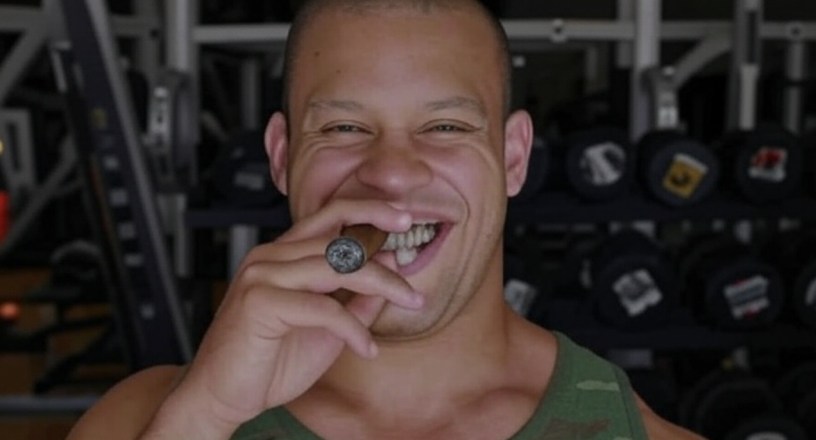
“From Strongman Mentor to Beard-Oil Prophet of Toxic Masculinity”
I used to follow Elliott Hulse.
Not religiously, but I liked him. Like “Yo, bro, this guy is dropping some real inner-grounding warrior wisdom” type of following.
Back when he was in his prime — chopping logs, talking about breathing from your belly, balancing your chakras while deadlifting — the man was real. A philosopher-meets-meathead blend of energy that somehow didn’t feel performative.
He wasn’t trying to sell you a Rolex fantasy or scream over trap beats about being “high value.”
He was just a big jacked dude in a garage telling you to “breathe into your balls,” and weirdly? It worked. It was honest. You could feel he’d done the inner work — or at least was trying.
There was a spiritual rawness to him. He wasn’t afraid to talk about trauma, grief, or the gut-wrenching pain of not being enough. And he didn’t weaponize it — he shared it. That kind of openness from a guy who could bench a small car? Unheard of.
He made you feel like it was okay to be broken, as long as you were rebuilding. There was no fake flex, no snake oil. Just real muscle and real shadow work. He was proof that masculinity didn’t have to be cruel — it could be conscious.
📈 From Strongman Sage to YouTube Yoda
There was a time when Elliott Hulse was it on YouTube fitness.
We’re talking 2012 golden era. No one else was mixing physical training with emotional wisdom and raw vulnerability quite like him. He talked about “becoming the strongest version of yourself” — and you felt that. It wasn’t just reps and sets. It was shadow work, trauma release, bioenergetics, primal screaming in your car if that’s what it took.
Dudes followed him not because he sold a fantasy, but because he gave you tools.
He wasn’t flexing Bugattis or selling masculinity courses for $499. He was talking about being grounded, spiritual, and emotionally honest — and doing it with traps bigger than your head.
He had range. One video would be about deadlifts, the next about father wounds, the next about posture and chi. It was chaotic, but it was authentic chaos. You never felt like he was pushing an agenda. He was just speaking from somewhere real. That’s rare now — influencers today rehearse vulnerability like it’s stand-up comedy.
He wasn’t trying to make men superior — he was trying to make them whole. That’s the version of Elliott who mattered. Not the caricature he became, but the blueprint he once laid out for men trying to climb out of generational shame.
⚠️ The Shift: Enter the “Alpha”
Somewhere around 2016–2018, things got weird.
He started shaving his head. Started talking slower. Got way into “masculine polarity” and started using words like “feminine chaos” unironically. The breathing coach became a Red Pill renaissance priest, spitting out hot takes that sounded less like self-mastery and more like insecure dude-splaining.
Gone were the videos about dealing with grief or childhood trauma.
Now it was all “Men need to be kings,” “Women need to submit,” “Don’t be a soyboy,” and other phrases ripped straight from a basement podcast hosted by a guy who’s afraid of almond milk.
He started sounding less like a teacher and more like a cult recruiter. His advice turned black-and-white, wrapped in Bible quotes and tribal masculinity. It went from “own your wounds” to “real men don’t cry” so fast it gave me whiplash. There was no room for nuance anymore — only obedience.
And what’s worse? He dressed it up as truth. As if doubling down on dogma somehow made him more grounded. Spoiler: it didn’t. It made him louder, not deeper. Less wise, more rigid. And all of it cloaked in this aesthetic of pseudo-philosophy that’s basically Jordan Peterson in gym shorts.
💀 Why It’s Toxic — and Not Actually Alpha
Let’s be clear: what Elliott does now isn’t alpha. It’s cosplay.
It’s a performance built on insecurity — the kind where confidence is replaced by control, and leadership is replaced by compliance. It’s not about becoming strong, it’s about appearing untouchable. Bulletproof. Emotionless. Robotic.
That’s not growth. That’s a spiritual lobotomy in a tight t-shirt.
This kind of content radicalizes insecurity. It tells young men that the world is hostile and the only way to survive is to dominate — emotionally, financially, physically. It hijacks pain and rebrands it as superiority. That’s not empowerment — it’s fear in a tank top.
The truth is, real alpha energy doesn’t need to scream. It doesn’t fear emotion. It doesn’t collapse under feminine energy — it collaborates with it. But that nuance doesn’t sell course bundles. Rage does. Simplicity does. Blame does. And that’s the toxin he’s feeding now.
🪦 The Disappointment
It’s honestly tragic.
To watch someone who helped so many step into themselves… turn into a caricature of the very thing he used to dissect. It’s like if Mr. Miyagi joined Fight Club and started selling NFTs about how crying is for betas.
I stopped following him. Not out of hate — maybe out of heartbreak.
Because I believed in the old Elliott. I grew to some extent because of that man. And now, he’s feeding the algorithm a script built on fear, shame, and gender role cosplay. Not power. Not presence. Just posturing.
It hurts in a very specific way when someone who taught you how to be human… decides to be a brand instead. Especially a brand built on everything he once challenged. It’s like watching your old therapist become a QAnon fitness influencer.
And the worst part? People still worship it. Because angry certainty is seductive — and vulnerable growth? That’s hard. He knew that once. I think he forgot.
🧠 Final Thoughts Before Cruce Is Out
This isn’t a “cancel him” post. This is a wake up post.
If you’re still watching Elliott and thinking this is what strength looks like — step back. Ask yourself who you’d be without the performative hardness. Without the war metaphors. Without the hierarchy.
Because real men don’t need to be alphas.
They need to be human.
I still think the old Elliott Hulse is in there somewhere. The one who screamed in fields and journaled about soul wounds. The one who helped broken men find breath again. But he’s buried beneath ego and algorithms now. And unless he lets go of the act, he’ll never find his own voice again.
Until then, I’ll raise a cup to who he used to be — and hope that someday, the strongest version of Elliott Hulse finally finds his way back.
Discover more from Adrian Cruce's Blog
Subscribe to get the latest posts sent to your email.
 Adrian Cruce's Blog